Opened your latest utility bill and winced? You’re not alone. The U.S. Department of Energy says heating and cooling make up about half of a typical home’s energy use, and rising electricity and gas rates make that hard to ignore.
A smart thermostat is one of the simplest ways to push that number down. By learning your routine, adjusting when you’re away, and using weather data, models like the Google Nest and ecobee can trim a meaningful slice off your heating and cooling costs.
- Expect savings from the high single digits to the mid-teens in percent on heating and cooling. This is not a guarantee.
- Many homes earn the cost back in one to three years, faster with a utility rebate.
- Check for a C-wire before you buy.
How smart thermostats work
Old programmable thermostats need manual schedules, and many people never set them up, so the system runs on a schedule that doesn’t match real life. Smart thermostats automate that.
Geofencing
Your phone’s location tells the thermostat when you leave, so it switches to an energy-saving setback and warms or cools the house again as you return.
Learning schedules
Over the first week or two, the device watches your manual changes and builds a schedule around your routine.
Adaptive recovery
Instead of switching on at exactly 6:00 PM, it works out how long your HVAC takes to reach the target, so the house is comfortable when you arrive without running longer than needed.
What can you realistically save?
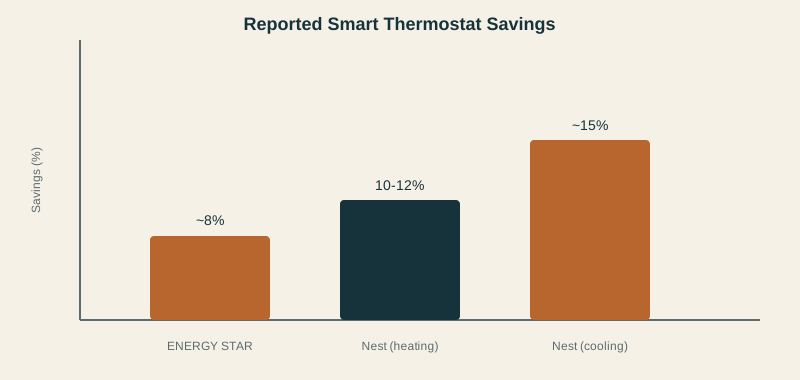
Lower bills
HVAC is usually the biggest energy draw in a single-family home, so trimming its run time is where savings come from. Payback depends on your climate, rates, insulation and habits.
Utility rebates
Many utilities and co-ops offer rebates or bill credits for qualifying thermostats. Check your provider’s website or the ENERGY STAR Rebate Finder before you buy.
Control from anywhere
Adjust the temperature from your phone on vacation, at work or in bed, so you never heat an empty house after a surprise trip.
Smart thermostats compared
| Model | Best for | Standout feature |
|---|---|---|
| Google Nest Learning Thermostat | Hands-off households | Sleek design and self-learning schedules |
| ecobee Smart Thermostat Premium | Larger or multi-room homes | Room sensors balance temperatures across floors |
| Honeywell Home T9 | Mid-range budgets | Smart room sensors, straightforward interface |
Features, prices and HVAC compatibility change. Confirm on the manufacturer’s compatibility checker before you buy.
Installation tips
- Check compatibility. Most models want a C-wire for steady power. If you don’t have one, see whether the box includes a power adapter kit.
- Turn off the power. Switch off the HVAC breaker before removing the old faceplate to avoid shorting the low-voltage circuit.
- Photograph the wires. Snap a picture of the terminals (R, W, Y, G and so on) before disconnecting. If the wiring looks unfamiliar, hire a licensed HVAC technician.
How we research and rank
Saima compares manufacturer specifications, published efficiency studies, utility rebate programs and verified owner reviews. Rankings come from that research, not from paid placement. Affiliate commissions never decide where a product lands.
Final thoughts
For most homeowners, a smart thermostat is one of the more cost-effective efficiency upgrades available. It trims wasted heating and cooling, protects your budget and makes the house more comfortable.
Saima is an independent, self-taught home energy researcher who breaks down utility costs and smart-home upgrades for U.S. homeowners. Questions? admin@ushomewatt.com